From vision to reality – circularity is a strategic imperative for Europe
By Steve Claus, Secretary General Steel for Packaging Europe
At a time of growing geopolitical uncertainty and resource constraints, Europe’s transition to a circular economy is no longer just an environmental ambition - it is a strategic necessity.
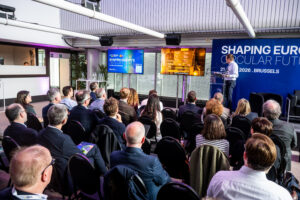 This was the clear message emerging from Steel for Packaging Europe’s “Shaping Europe’s Circular Future” event, where policymakers and industry leaders converged around one central idea: materials must remain resources, not become waste.
Opening the event celebrating the association’s 40th anniversary, Steel for Packaging Europe President Richard Lézé reflected on four decades of progress. What began as a sectoral association has evolved into a sustainability-driven industry voice, advocating for one of the most circular packaging materials available today. Yet the message was forward-looking: while circularity is already happening, scaling it across all sectors and Member States remains the real challenge.
 That urgency was echoed by keynote speaker MEP Susana Solís, who placed circularity firmly within the context of Europe’s economic resilience. With global supply chains under strain and access to critical raw materials increasingly uncertain, Europe faces a stark reality: dependence on imports is a vulnerability.
Circularity offers a solution.
Every tonne of material recycled domestically is a tonne that does not need to be imported. Every efficient recycling loop strengthens Europe’s industrial autonomy. In this sense, circular economy policy is not just environmental policy - it is industrial strategy.
However, the gap between ambition and reality remains significant. Europe’s circularity rate today stands at around 12%, with a target to reach 24% by 2030. Achieving this will require more than incremental change. It demands systemic alignment between policy frameworks, industry practices, and market incentives.
Steel packaging provides a compelling example of what is already possible. With over 82% real recycling rate and the ability to be recycled indefinitely without loss of quality, it demonstrates how a “closed material loop” can function at scale. Its inherent properties - such as easy magnetic separation and high scrap value - make it both economically and environmentally efficient.
But success stories alone are not enough.
 Speakers repeatedly emphasised the need for collaboration across the entire value chain. From design and production to collection, sorting, and recycling, each actor must play a defined role within a predictable and harmonised system. Fragmentation -particularly across 27 national frameworks - remains a major barrier.
Policy, therefore, has a critical role to play. It must create conditions that reward materials and systems that already deliver high-performance circularity, while also driving improvements where gaps remain. This includes ensuring fair and transparent frameworks, and rewarding actual recycling performance.
Equally important is the need for reliable data, as highlighted by keynote speaker MEP Bruno Tobback. Without accurate, audited, and harmonised reporting, it is impossible to measure progress or build trust between stakeholders.
As several other speakers also noted, circularity must be measurable to be meaningful.
 The takeaway from the event is clear: Europe has the tools, technologies, and expertise to lead in circularity. What is needed now is implementation at scale.
This means moving beyond debate toward action - aligning policy with real-world performance, investing in proven solutions, and strengthening collaboration across industries and borders.
Because in today’s world, circularity is not just about sustainability. It is about competitiveness, resilience, and Europe’s ability to shape its own future.
Read our 2026 Recycling report "Steel Ahead: Packaging for a circular future" released at the event here.