STEEL FOR PACKAGING EUROPE HIGHLIGHTS CIRCULAR STEEL’S ROLE IN CLIMATE ADAPTATION AT BRUSSELS CLIMATE WEEK
 Taking place this week 12–16 October 2026, Brussels Climate Week brings communities, policymakers and industry leaders together, to examine how policy and innovation can accelerate Europe’s path toward circularity and competitiveness.
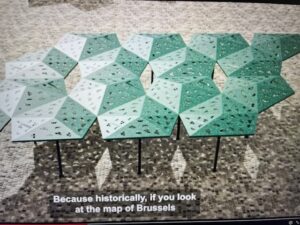
Steel for Packaging Europe (SfPE), as networking lounge sponsor, is spotlighting two concepts from the City of Brussels’ shade structures competition to develop innovative shade structures for urban spaces. Both concepts provide practical responses to the growing challenge of urban heat, illustrating circular design in action and demonstrating how existing materials can be given new uses.
 Steve Claus, Secretary General of Steel for Packaging Europe, said: “The challenge presented by climate change driven events such as more frequent and prolonged heatwaves has never been greater and adaptation is an urgent requirement.
“By challenging students, architects, designers and other Brussels-based stakeholders to develop creative but practical solutions which can provide shade in urban spaces, the competition has produced tangible examples of circular design. The winning concepts demonstrate how valuable materials such as steel can be kept in circulation for as long as possible.”
Selected by a jury appointed for the City of Brussels’ shade-structures competition, the two winning concepts also reflect the city’s industrial and cultural heritage. Inspired by the historic layout of Brussels city centre, the Pentagon Shade makes use of steel to provide a modular, light and recognisable structure that can be adapted to suit a variety of public spaces. Meanwhile the Shade Tram Rails project repurposes the city’s steel tram rails as load bearing supports in a concept which is demonstrably credible, easy to reproduce and sustainable. All the projects submitted will inform future discussions on adapting public spaces to heatwaves.
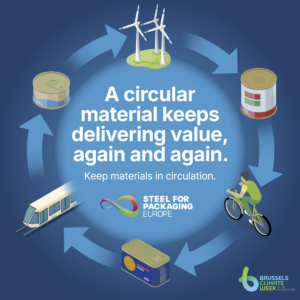
Mr Claus added: “Circularity is not only about what happens to a product and the material it is made from at the end of its life. It is about keeping that material in circulation for as long as possible.
“Recycled steel packaging can be used to make new steel products across a wide range of applications, retaining the inherent properties and value of the material. This is what makes steel a permanent material: it can move from one application to another and continue to deliver value.
“This type of circular thinking that is critical to a resource-efficient economy. Rather than treating materials as waste at the end of a product’s first life, we need to recognise their continuing value and enable them to be used again and again.
“Indeed, the record steel packaging recycling rate of 84%[1] demonstrates that large quantities of steel packaging are already being recovered as a valuable secondary raw material. Steel scrap is a vital element in the production of new steel, serving as a cooling agent. Keeping steel in circulation therefore supports both resource efficiency and the competitiveness and resilience of Europe’s steel value chain.
 The Association looks forward to participating in a constructive and informative programme in partnership with Brussels Climate Week, to help demonstrate exactly what a circular material economy looks like when it moves from policy language into real life. Steve Claus will be a speaker at today’s session on Circular Economy.
[1] Steel packaging recycling rate reaches record high - Steel for packaging Europe